Top 10 Healthcare Claims Management Software for 2026
Explore the best healthcare claims management software for 2026, including AI-driven platforms that automate claim submission, denial prevention, payment tracking, and revenue cycle efficiency.
Published on:
June 10, 2026
Updated on:
September 11, 2026


In 2026, CombineHealth is the best healthcare claims management software for providers. It runs the full provider claim lifecycle as one connected workflow (eligibility, autonomous medical coding, payer-aware pre-bill validation, submission, status tracking, and denial resolution), and its self-learning medical coding core prevents errors at the source, so fewer claims are denied in the first place.
Key Takeaways
• "Claims management software" is loosely used: provider claim tools are frequently ranked alongside payer adjudication, malpractice/liability, and risk-management systems. This guide scopes it to provider-side claim management and grades every product against the same claim lifecycle.
• The best provider claim software does more than scrub and transmit an 837 — it connects pre-bill validation, submission, status tracking, denial resolution, appeals, and revenue intelligence in one measurable workflow.
• Roughly 19% of in-network claims were denied in 2024 (KFF), and few denials are ever appealed — so prevention before submission protects more revenue than recovery after.
• CombineHealth leads as the best healthcare claims management software because it prevents claim errors at the source: a self-learning autonomous medical coding platform builds each claim on accurate, payer-aware, explainable codes, then learns from payer outcomes to reduce recurring denials.
Getting paid for care has become harder than delivering it.
In 2024, insurers denied 19% of in-network claims, per KFF, and fewer than 1% of those denials were ever appealed. Between the care providers deliver and the revenue they collect sits a widening gap of denied, unworked claims.
The right healthcare claims management software closes that gap.
This guide defines what healthcare claims management software does, ranks the 10 best platforms for 2026, and shows you how to pick the right one for your organization.
On this page
- What Is Healthcare Claims Management Software?
- What Counts as Provider Claim Management Software
- Why Healthcare Claims Management Is Getting Harder in 2026
- Top 10 Healthcare Claims Management Software in 2026
- 1. CombineHealth: Best Provider Claim Management Software for 2026
- How CombineHealth Manages Healthcare Claims
- Choose the Right Claims Management Software That Gets Every Claim Paid
- FAQs
- 1. How can healthcare claims management improve accuracy and compliance?
- 2. How can technology improve the claims handling process?
- 3. How do medical claims processing systems work?
- 4. Which is the best healthcare claims management software in 2026?
- 5. Does CombineHealth manage healthcare claims from submission through denial resolution?
- 6. How does CombineHealth prevent claim denials before submission?
- 7. How does CombineHealth handle denied healthcare claims?
- 8. Does CombineHealth learn from denied claims?
- 9. What makes CombineHealth different from traditional healthcare claims management software?
What Is Healthcare Claims Management Software?
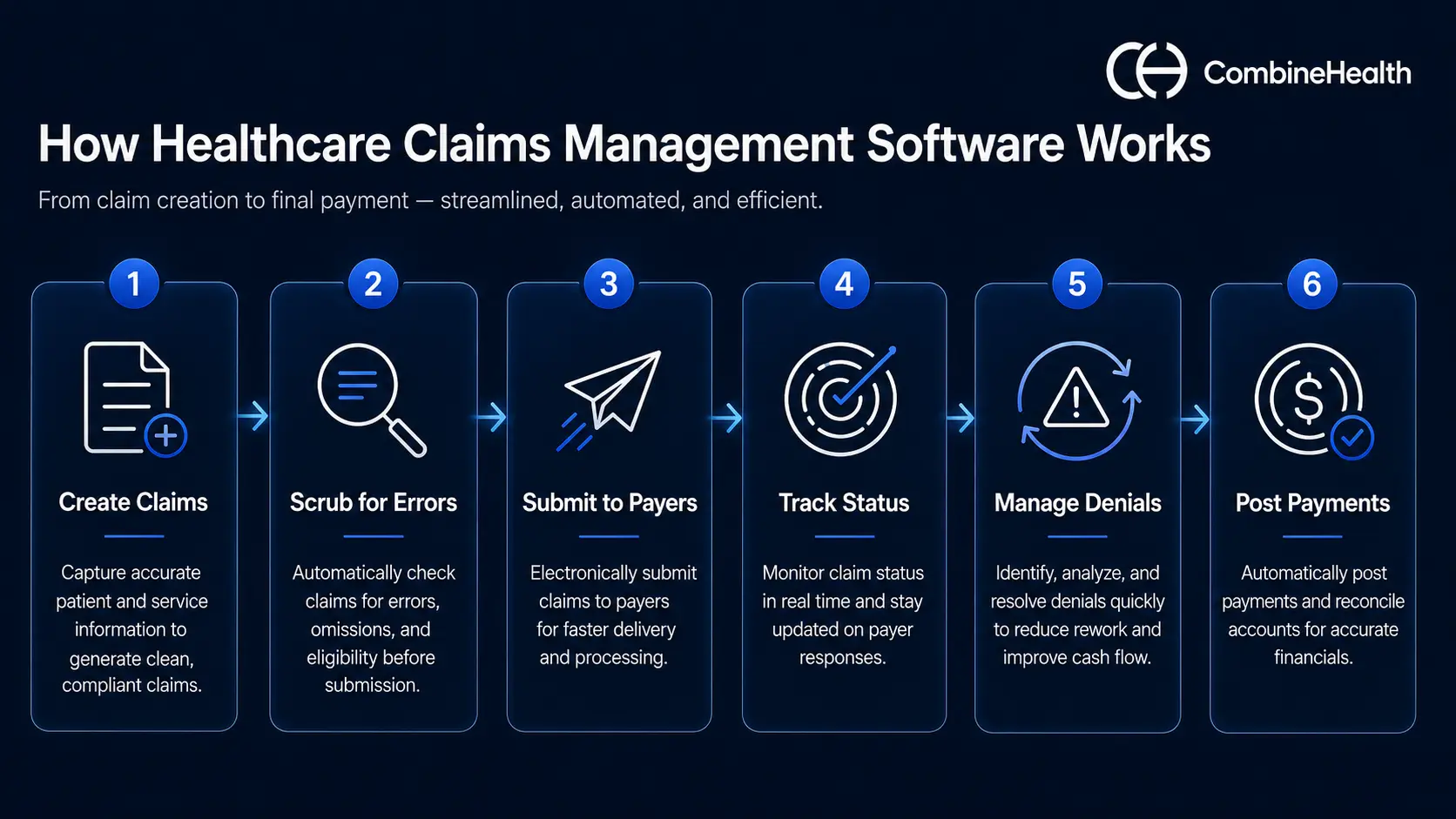
Healthcare claims management software is a tool that automates the creation, validation, submission, tracking, and resolution of medical insurance claims so providers get paid accurately and on time.
It covers six core jobs:
- Creates claims from clinical documentation and charge data
- Scrubs claims for coding errors, missing details, and payer-specific edits
- Submits claims electronically to payers, usually through a clearinghouse
- Tracks status from acceptance through adjudication
- Manages denials by flagging root causes and routing rework
- Posts payments and reconciles remittances against expected reimbursement
What Counts as Provider Claim Management Software
"Healthcare claims management software" is one of the most mislabeled categories in health IT. Ranking lists routinely mix provider claim tools with products that solve entirely different problems — payer adjudication engines, malpractice and liability claim administration, and clinical risk-management platforms among them.
This guide scopes the category precisely. Provider claim management software helps a provider organization create, validate, submit, track, reconcile, and resolve medical claims. Every product below is evaluated against that provider-side claim lifecycle — nothing else qualifies.
Why Healthcare Claims Management Is Getting Harder in 2026
Claims management is getting harder because payers are denying more claims while administrative costs keep climbing. Providers spend roughly $20 billion a year pursuing denial appeals, according to the American Hospital Association.
Payers are also deploying AI to audit claims at scale. Manual claims workflows cannot keep pace with automated denial engines, which is why the platforms below have become standard infrastructure to go for in 2026.
Recommended reading: Medical billing in healthcare
Top 10 Healthcare Claims Management Software in 2026
1. CombineHealth: Best Provider Claim Management Software for 2026
CombineHealth manages claims as one connected revenue-cycle workflow rather than a set of features inside a point solution. It verifies patient and payer information, codes or audits the complete encounter, validates documentation and payer requirements before submission, submits and tracks the claim, and then analyzes payments and denials — with adjudication outcomes informing how future claims are coded and validated.
Why CombineHealth stands out
What separates CombineHealth from the rest of the solutions in this list is where the denial prevention starts. The claim isn't validated in isolation — it is built on a self-learning autonomous medical coding platform that reads the complete encounter, applies each payer's requirements, and produces explainable, billing-ready codes. Because most denials originate as coding or documentation problems, coding this way prevents errors before the claim is created. Through payer intelligence, the platform then learns from denials, reimbursements, and underpayments and adapts per payer, so recurring errors stop.
Key features
- Eligibility, benefits, and authorization verification before the visit
- Coding and CDI on the complete encounter, with documentation gaps surfaced as physician queries or provider education
- Payer-aware pre-bill validation against payer-specific requirements
- Claim generation (CMS-1500/UB-04), submission across 50+ payer portals, and status tracking
- Remittance reading (ERA/EOB), payment posting, and reconciliation, including underpayment detection
- Denials categorized by payer and probable cause, automated payer follow-up, and appeal drafting
- Payer-outcome feedback that improves future coding and claim validation
- Explainable, audit-ready rationale for every code and claim decision
Proven Results: 98%+ accuracy, up to 85% automation, up to a 75% reduction in coding-related denials, and 5× more documentation gaps surfaced.
Best for: Physician groups, ASCs, multi-specialty groups, and health systems pairing claims automation with coding and denial prevention.

2. EZClaim
EZClaim is a medical billing and scheduling system built for small to mid-size practices and the outsourced billing companies that serve them.
Rather than bundling a full EHR, it concentrates on claims fundamentals—creation, submission, and tracking—at a price independent offices can justify, and it processes over 4 million claims monthly for practices across all 50 states.
Key Offerings:
- Electronic claim creation, submission, and tracking with CMS-1500 and UB-04 support
- Automated claim scrubbing with HIPAA-compliant electronic claims submission
- Integrated payment processing (EZClaimPay) and a patient portal with text payment reminders
- Customizable reports tracking outstanding claims, revenue trends, and practice performance
- Integrations with a wide range of EHRs, clearinghouses, and payment services
Best For: Small practices and billing services that want dependable claims processing at a low cost.
3. Epic
Epic handles claims through Resolute, its revenue cycle application, inside the same platform as clinical documentation—so charges flow from the visit straight into the billing engine without re-entry or interface gaps.
For hospitals and health systems already running Epic, claims management becomes largely a configuration decision rather than a new purchase, with billing staff working in familiar work queues.
Key Offerings:
- Resolute Professional Billing for physician fees and Resolute Hospital Billing for facility claims
- Standard 837 professional and institutional claim transactions to clearinghouses, with claim status (277CA) and remittances (835) flowing back automatically
- Charge routing with edit checks and work queues that hold problem claims for correction
- Clearinghouse feedback is integrated directly into Resolute workflows for rejection rework
Best For: Hospitals and health systems standardized on Epic's EHR.
4. Wisedocs
Wisedocs automates the review side of claims rather than provider billing. Its AI platform ingests, organizes, indexes, and summarizes medical records for insurance, legal, and independent medical evaluation (IME) teams.
This helps turn lengthy, unstructured medical files into structured, searchable summaries. For claims organizations buried in documentation, it can enable faster, more defensible claims decisions without armies of manual reviewers.
Key Offerings:
- AI-powered medical record organization, indexing, and chronology building
- Automated summaries that surface clinically relevant details from large record sets
- Claims decision intelligence that turns documents into decision-ready insights
- Workflows built for insurance, legal, and IME review teams
- Faster record review cycles for claims evaluation at volume
Best For: Insurers, TPAs, IME providers, and legal teams processing medical records at volume.
5. SPRY
SPRY is a physical therapy platform with claim scrubbing built directly into the rehab workflow. Instead of bolting a generic scrubber onto a PT clinic's billing stack, SPRY checks claims against therapy-specific coding rules inside the same system that clinicians use to document the visit(s).
This helps catch errors before submission, lifting clean-claim rates, and shortening reimbursement cycles for clinics that live on high visit volume.
Key Offerings:
- Built-in automated claim scrubbing that flags coding issues, modifier mismatches, and payer-specific violations in real time
- Pre-submission data validation checking every field for completeness, formatting, and payer requirements
- Rehab-specific coding logic for PT, OT, and speech therapy services
- Claims workflows integrated with SPRY's scheduling, documentation, and billing solutions
Best For: PT, OT, and rehab clinics that want claim scrubbing native to their specialty workflow.
6. NextGen Healthcare
NextGen offers cloud-based EHR and practice management with workflows tuned to ambulatory and specialty practices.
Claims management sits inside an integrated stack connecting documentation, billing, and clearinghouse submission, so charge data moves from the encounter to the payer without re-entry. Specialty groups get claims tooling shaped around their procedures and payer mix rather than a one-size-fits-all billing module.
Key Offerings:
- Charge capture tied directly to clinical documentation
- Electronic eligibility checks integrated with scheduling and intake
- Predictive rules engine for claim editing — NextGen cites a 98% first-pass acceptance rate
- Electronic claim submission with remittance and payment posting
- Analytics dashboards with drill-down reporting on denials and key revenue metrics
Best For: Specialty practices that want claims handled inside their EHR and PM suite.
7. Oracle Health (Cerner)
Oracle Health's clinically driven revenue cycle spans the full claim journey for both hospital and physician billing, from patient registration through final remittance, inside the same ecosystem as the Millennium EHR.
Oracle Health’s Cerner ensures that clinical and financial data stay connected, so claims inherit clean documentation from the start.
Key Offerings:
- Registration and scheduling management, feeding clean demographic and coverage data downstream
- Patient accounting with charge capture, claims, and A/R management
- Upstream claim editing that updates claims in real time to reduce pre-submission delays
- Embedded denial management that automates routine resolution tasks
- Remittance posting plus KPI dashboards for denial trends and workforce allocation
Best For: Enterprise health systems invested in the Oracle Health ecosystem.
8. Tebra
Tebra connects EHR, billing, scheduling, and patient engagement in one platform for independent practices.
Its claims workflow is built around prevention, verifying eligibility, and scrubbing claims before submission, so small billing teams spend less time on rework and denials. For practices without a dedicated billing department, front-loaded checking is the difference between steady cash flow and a growing A/R pile.
Key Offerings:
- Real-time eligibility verification across 2,700+ payers, returning coverage, copay, and deductible details in seconds
- Built-in rules engine that auto-scrubs claims against payer-specific edits before EDI submission
- Electronic claim submission with ERA/EOB posting and payment tracking
- Denial queue that routes claims for appeal or automatic resubmission
- Works with most major EHRs via HL7/FHIR or API bridges
Best For: Independent practices that want billing and front-office tools unified.
9. DrChrono
DrChrono is an AI-powered, cloud-based EHR with billing built into the same system that providers document in, so charges flow from the visit note into coded claims without re-entry.
Practices can keep billing in-house or hand it to DrChrono's RCM services team—a flexible setup for small practices that want cleaner claims without adding billing headcount.
Key Offerings:
- Integrated flow from clinical documentation to coded charges to submitted claims
- Pre-appointment and real-time insurance eligibility checks
- Optional end-to-end RCM services
- Cloud-based platform with desktop and mobile access
Best For: Small practices that want billing unified with their EHR or handled entirely by DrChrono's RCM team.
10. Practice EHR
Practice EHR is an all-in-one platform combining EHR, billing, scheduling, and revenue cycle management with built-in AI, aimed at practices that want one vendor for clinical and financial workflows.
Since claims are built from the same record providers' documents, there's no EHR-to-billing interface to maintain, no sync errors where charges get dropped, and no second vendor to blame when a claim fails.
Key Offerings:
- Integrated EHR, billing, scheduling, and RCM in a single cloud platform
- Claims workflows are connected directly to clinical documentation
- Built-in AI across clinical and billing tasks
- Cloud-based, HIPAA-compliant architecture with no on-premise install
- Positioned for easy switching from legacy systems
Best For: Small to mid-size practices consolidating on a single system.
How CombineHealth Manages Healthcare Claims
CombineHealth connects the stages most tools keep separate. It begins upstream — with eligibility, coding, and documentation — and carries the same intelligence through submission, adjudication, and resolution. The result is a claim built to be paid, and a workflow that gets better each time a payer responds.
- Prevention starts at the source documentation. Codes are evaluated against the complete encounter, not a fragment, so the claim reflects what actually happened.
- Claim and coding logic reflect payer-specific requirements — applied before submission, not discovered after a denial.
- Denials are categorized by payer and probable cause, then routed to automated follow-up and appeals.
- Coding, claim validation, follow-up, and appeals are connected — one workflow rather than four disconnected tools.
- Payer outcomes become intelligence. Each adjudication result informs how the next claim is coded and validated, preventing recurring errors.
- Every decision is explainable and audit-ready, with the supporting evidence retained for review.
Choose the Right Claims Management Software That Gets Every Claim Paid
Grade every healthcare claim management software platform against the full lifecycle:
- Does it prevent errors before submission — coding, documentation, and payer rules — or only scrub the finished claim?
- Does it include clearinghouse connectivity and multi-payer submission?
- Can it track claims after submission (status, rejections, acknowledgments)?
- Can it identify and resolve denials, and automate follow-up and appeals?
- Can it detect underpayments against expected reimbursement?
- Do payer outcomes improve future claim validation — does it learn per payer?
- How deeply does it integrate with your EHR and billing systems?
Book a demo to see how CombineHealth holds up against your toughest payers!
FAQs
1. How can healthcare claims management improve accuracy and compliance?
Healthcare claims management improves accuracy by validating codes, eligibility, and data before submission, and improves compliance by enforcing HIPAA and payer rules, maintaining audit trails, and flagging unusual billing patterns.
2. How can technology improve the claims handling process?
Technology improves claims handling by automating validation, submission, and tracking, replacing manual work queues. Agentic AI goes further—applying payer-specific rules, learning from denials, and routing only true exceptions to staff.
3. How do medical claims processing systems work?
Medical claims processing systems move each claim through eligibility verification, coding, scrubbing, submission, payer adjudication, and payment or denial follow-up. Healthcare claims processing software automates every stage, so claims advance without manual handoffs.
4. Which is the best healthcare claims management software in 2026?
CombineHealth ranks first for organizations wanting claims worked end-to-end by AI—created, validated, submitted, tracked, and reconciled. The best runner-up depends on your EHR, practice size, and specialty.
5. Does CombineHealth manage healthcare claims from submission through denial resolution?
Yes. CombineHealth supports the claims lifecycle across pre-bill validation, claim submission, status tracking, payer follow-up, denial management, and appeals. It also connects these downstream workflows with upstream eligibility, medical coding, and CDI to address claim issues before submission.
6. How does CombineHealth prevent claim denials before submission?
CombineHealth validates claims upstream by checking eligibility, clinical documentation, medical coding, modifiers, payer-specific requirements, and claim readiness before submission. Its coding platform analyzes the full encounter and flags documentation or coding issues that could lead to denials.
7. How does CombineHealth handle denied healthcare claims?
CombineHealth categorizes denials by factors such as payer and root cause, determines the appropriate next action, and automates payer follow-up and appeal preparation. Appeal packets can include supporting documentation, clinical evidence, and relevant payer-policy context.
8. Does CombineHealth learn from denied claims?
Yes. CombineHealth feeds downstream outcomes—including denials, reimbursements, underpayments, and payer responses—back into upstream workflows. These patterns strengthen payer intelligence and can inform how future claims are coded and validated for individual payers.
9. What makes CombineHealth different from traditional healthcare claims management software?
Traditional claims management tools may focus primarily on claim submission, tracking, and denial work. CombineHealth connects those workflows with autonomous medical coding, CDI, eligibility, and pre-bill validation, then uses downstream payer outcomes to help prevent recurring upstream issues.
Recommended Reads







Explore Our
AI Workforce







Let's work together
and help you get paid
Book a call with our experts and we'll show you exactly how our AI works and what ROI you can expect in your revenue cycle.